Get a tailored quotation for pressure vessel heads, stainless spheres, or firepit bowls. Our engineers review your drawings, materials, standards, and quantities to provide accurate pricing and delivery options.
Custom Fabrication to Drawing
ASME & PED Compliance Support
Wide Material Capability
Strict Quality & NDT Control
Fast Lead Time & Stable Supply
Engineering Review Before Production
Request a Quote for Custom Tank Heads
Get a tailored quotation for pressure vessel heads, stainless spheres, or firepit bowls. Our engineers review your drawings, materials, standards, and quantities to provide accurate pricing and delivery options.
Elliptical vs Torispherical Heads: What’s the Difference
A few years ago, a buyer emailed me a drawing and one line of panic:
“Can you quote this head cheaper if I switch the shape?”
I stared at the sketch, sipped my coffee, and thought, Yep. This is the question. Because “elliptical” and “torispherical” heads look kind of similar to normal humans… until you start paying for steel, press time, weld prep, and code thickness.
So let’s talk like real people. No textbook voice. No fluff. Just what changes, what it costs you, and how I decide which one I’d pick.
Table of Contents
First—what are we even comparing?
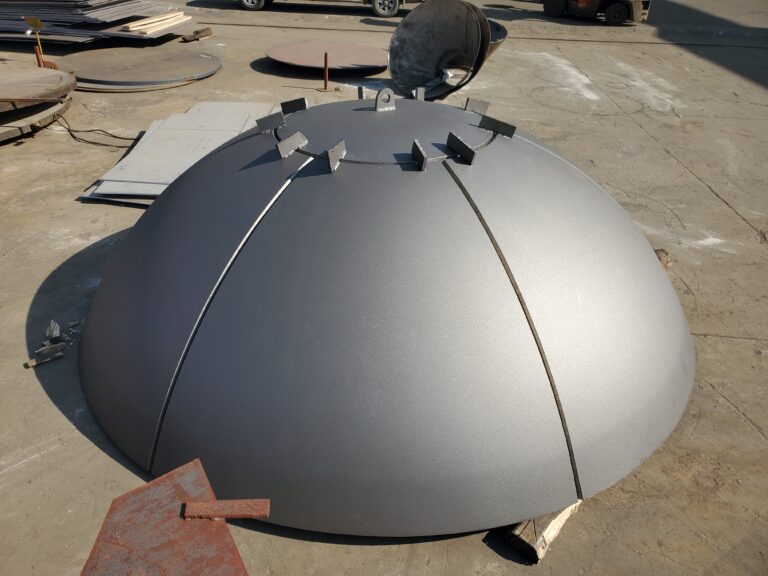
When people say elliptical head in pressure vessels, they usually mean a 2:1 ellipsoidal head.
That “2:1” matters. It means the ellipse shape follows a standard proportion that codes and shops understand. It’s a smooth, continuous curve from the crown down to the weld line.
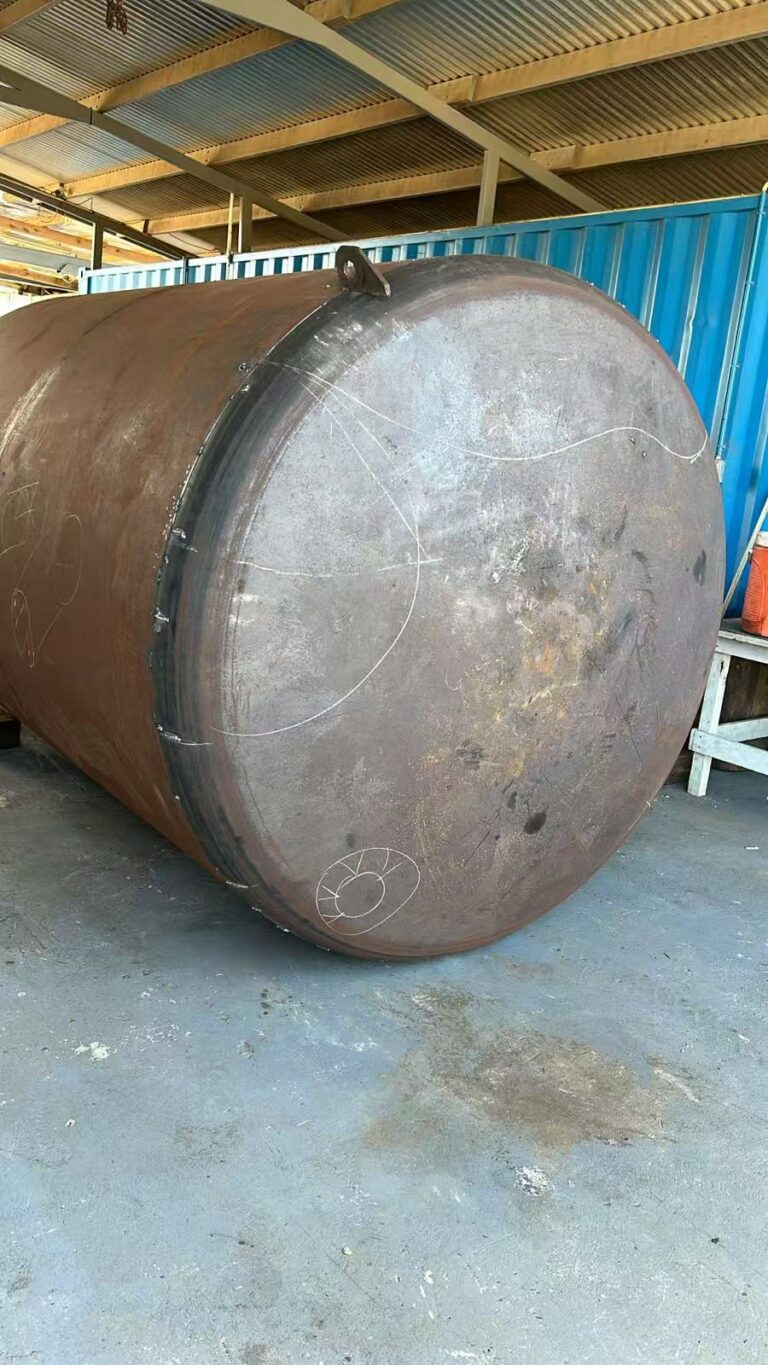
A torispherical head (often called ASME flanged & dished, or “F&D”) uses two radii:
a spherical crown (the big main dish)
a knuckle radius near the edge (the tighter bend where stress loves to hang out)
Two families. Two personalities.
One flows like a smooth hill. The other looks like a dinner plate with a rolled lip.
Elliptical (2:1 ellipsoidal)
Smooth curve the whole way. No sudden “corner-ish” area near the edge.
If you run your finger along the profile, it just… keeps going.
Torispherical
Big gentle dish in the middle, then it tightens up near the edge in the knuckle area.
That knuckle behaves like the “problem child” when pressure ramps up.
And yes, engineers obsess over that knuckle. For good reason.
Here’s the part nobody tells buyers: stress doesn’t “feel” the same
Pressure doesn’t push evenly in the way your gut assumes.
With an elliptical head, the stress spreads out more smoothly over the surface. That usually lets you hit a given pressure rating with less thickness compared to a torispherical head of the same diameter and material.
With a torispherical head, stress concentrates more near the knuckle and the transition area. So to satisfy code rules, you often need more thickness (or more careful design details).
Does that always happen? Not always. But it happens enough that I treat it like the default until proven otherwise.
And steel thickness changes everything. Weight. cost. forming difficulty. shipping. even how annoyed your rigging crew feels on install day.
Height: the sneaky difference that affects your vessel layout
Elliptical heads usually come deeper (taller) than torispherical heads for the same diameter.
That sounds boring until you try to fit the vessel into a tight plant space.
Got a skid? A container limit? A platform with pipes in the way? Suddenly head depth turns into a real-life problem, not a drawing detail.
If you need a shallower overall vessel, torispherical often wins the layout argument.
If you need better pressure efficiency, elliptical often wins the thickness argument.
See the trade? Always a trade.
Cost: why torispherical often shows up in “budget” designs
Let me be blunt.
If you tell a shop: “Give me the most economical standard head,” you’ll hear torispherical a lot.
Why?
Shops stock tooling and dies around it.
It forms with less depth.
It often runs faster in production for common sizes.
A lot of buyers already accept it, so it moves through approval without drama.
But here’s the twist.
If your torispherical design forces a much thicker plate to meet code, you can burn those savings fast. Real fast.
So torispherical can cost less. It doesn’t automatically cost less.
I’ve watched people “save money” by switching shapes… and then lose it again on thickness, weight, and handling.
Ouch.
Welding and fit-up: the stuff you only learn after a few painful jobs
Both head types weld to the shell. No shock there.
But torispherical heads sometimes bring more fuss around the edge geometry and knuckle transition, especially if someone asks for tight tolerances, odd materials, or thicker plate.
Elliptical heads, with their smooth profile, can feel more predictable during fit-up in many standard builds.
Not always. Shops vary. Tooling varies. Operator skill varies.
Still, if I had to bet my weekend on “which one gives fewer surprises,” I often lean elliptical when pressure and thickness climb.
Performance: if you push pressure higher, elliptical starts looking smarter
Here’s a “coffee talk” rule that rarely steers me wrong:
Moderate pressure + common sizes + cost sensitive → torispherical pops up a lot
Higher pressure + weight sensitive + clean stress flow → elliptical starts looking like the grown-up choice
If your vessel lives in a high-pressure world, you and I both know what happens. Every extra millimeter of thickness becomes a tax on your budget.
And your crane.
And your schedule.
A quick comparison (the cheat sheet you actually wanted)
What you care about
Elliptical (2:1)
Torispherical (F&D)
Stress distribution
Smoother
More concentrated near knuckle
Typical required thickness (same dia/pressure)
Often thinner
Often thicker
Head depth (height)
Deeper
Shallower
Common availability
Very common
Extremely common
Cost at low/moderate pressure
Can cost a bit more
Often cheaper
Cost at higher pressure
Can save money via thinner plate
Can get expensive via thickness
Layout constraints
Needs more length
Saves length
No magic. Just trade-offs.
When I personally choose an elliptical head
If a friend asked me over coffee, “Which one should I pick?” I’d ask one question first:
How much pressure are you really dealing with?
Because I pick elliptical when:
pressure climbs and thickness starts to hurt
weight matters (shipping, lifting, installation)
the spec demands a more efficient head shape
I want fewer stress headaches at the edge region
the project owner loves conservative design choices
Elliptical feels like the “I don’t want surprises later” option in a lot of serious service conditions.
When I choose torispherical without overthinking it
I pick torispherical when:
the pressure sits in a comfortable mid-range
I need a shallower head to fit a tight overall length
the project screams “standardize it and move on”
the budget stays tight and the code calcs still look clean
the plant already uses F&D heads everywhere and hates change
Sometimes the best engineering choice looks boring.
Boring can be beautiful when the schedule looks ugly.
The questions I ask before I quote either one
Want to get a fast, accurate quote and not play email ping-pong for three days? Send these up front:
Design pressure and design temperature
Material (and corrosion allowance, if any)
Head type you want (2:1 elliptical or torispherical F&D)
Diameter, thickness preference (if you have one), and forming tolerances
Any special needs: PWHT, NDE level, edge bevel detail, straight flange requirements
Code standard you must follow (ASME, etc.)
And please—please—attach the drawing. Even a rough one.
I can’t “guess” your nozzle loads from vibes.
So… which one is “better”?
Neither. That’s the honest answer.
Elliptical wins when pressure efficiency and smoother stress flow matter. Torispherical wins when space, standard tooling, and cost pressure matter.
The only bad choice? Picking the shape because someone told you “it’s always cheaper” without checking thickness and layout.
If you want, paste your diameter + design pressure + material, and I’ll tell you which one I’d lean toward—and why. No salesman talk. Just shop-floor logic.