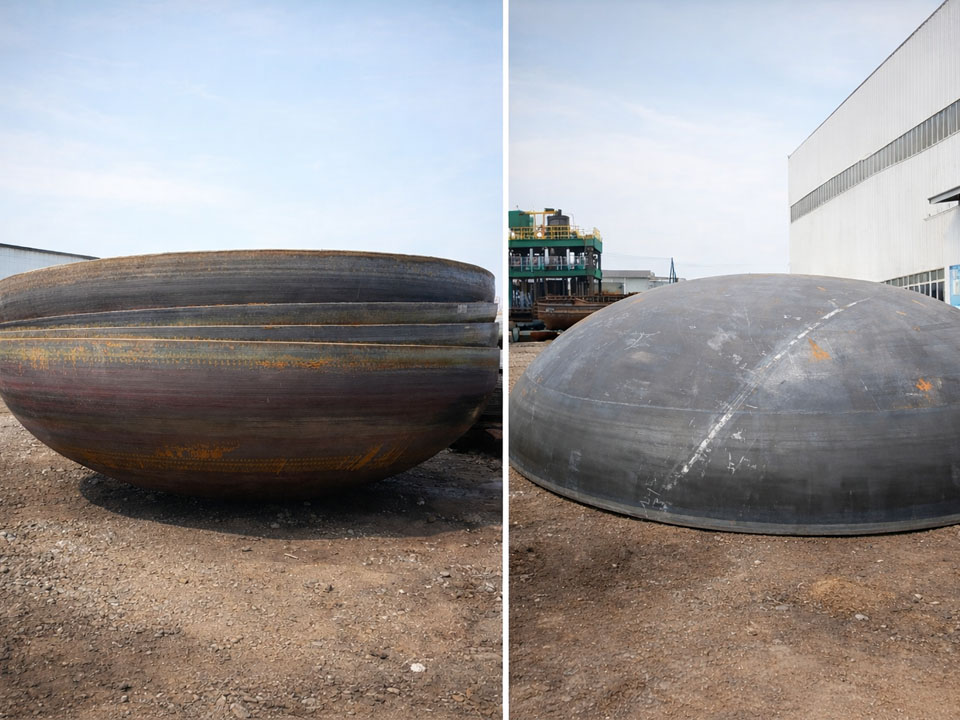
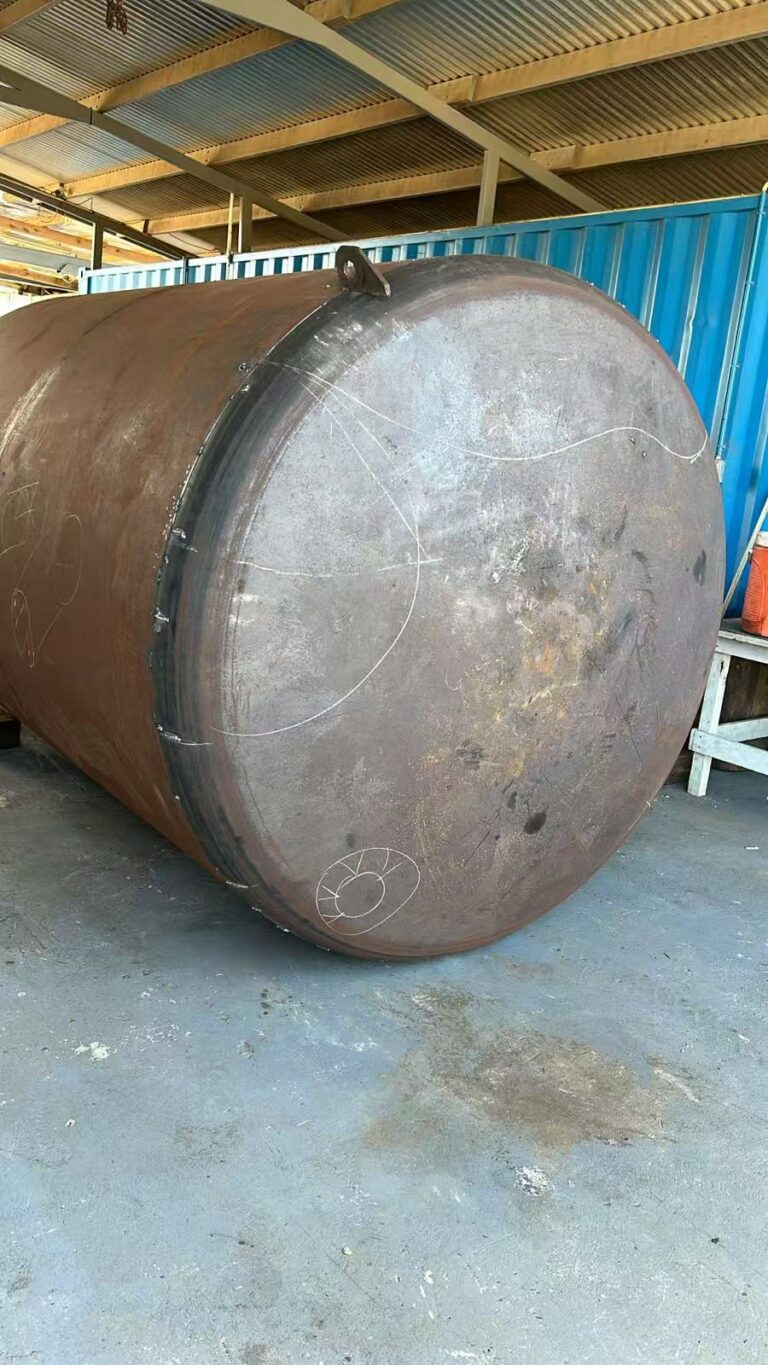
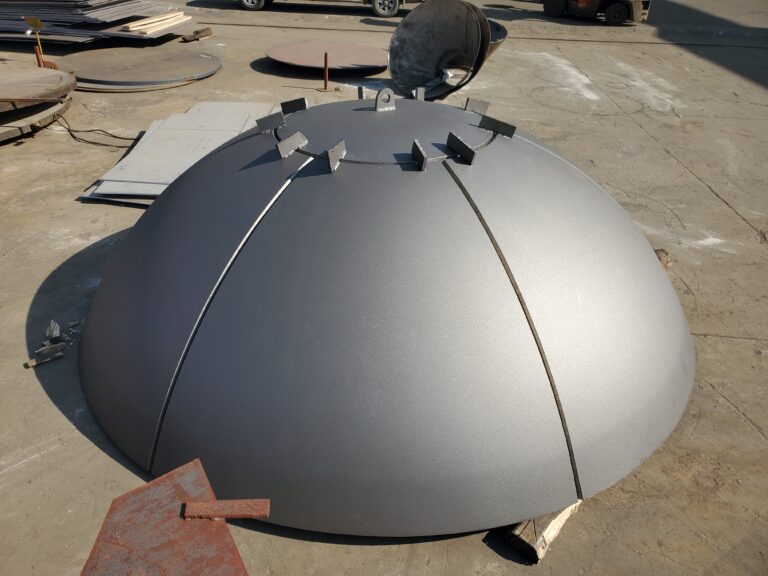
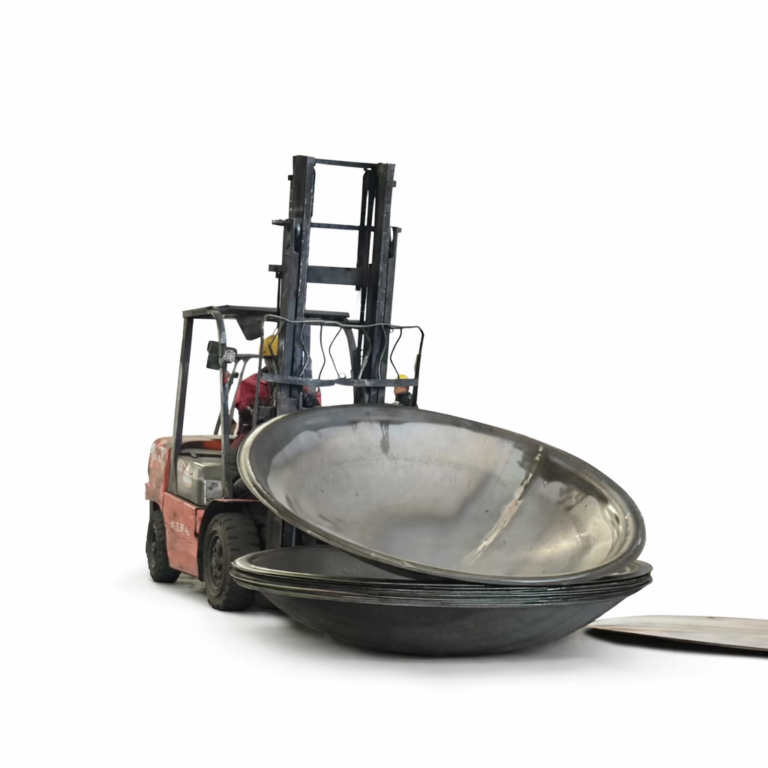
Get a tailored quotation for pressure vessel heads, stainless spheres, or firepit bowls. Our engineers review your drawings, materials, standards, and quantities to provide accurate pricing and delivery options.
Custom Fabrication to Drawing
ASME & PED Compliance Support
Wide Material Capability
Strict Quality & NDT Control
Fast Lead Time & Stable Supply
Engineering Review Before Production
Request a Quote for Custom Tank Heads
Get a tailored quotation for pressure vessel heads, stainless spheres, or firepit bowls. Our engineers review your drawings, materials, standards, and quantities to provide accurate pricing and delivery options.
What’s The Difference Between An Elliptical Head And An Ellipsoidal Head
An “ellipsoidal head” is a 3D head shape based on an ellipsoid (most commonly a 2:1 ellipsoid of revolution), while “elliptical head” is often a loose industry shortcut that may mean the same thing—or may mean “semi-elliptical” without specifying the ratio.
That one sentence explains 90% of the headaches I see on RFQs.
Table of Contents
Why does the wording get messy in real projects?
Because people mix 2D and 3D terms—and because “elliptical head” became shop slang.
An ellipse is a 2D curve (think: the outline you’d draw on paper).
An ellipsoid is a 3D surface (think: a stretched sphere).
A vessel head is a 3D formed part, so “ellipsoidal” is the technically clean word.
But in day-to-day manufacturing talk, buyers will say elliptical head when they really mean 2:1 ellipsoidal head (also called a semi-elliptical head in some contexts). And yes, that “some contexts” part is the trap.
Are “elliptical head” and “2:1 ellipsoidal head” the same thing?
In many pressure-vessel shops, “elliptical head” = “2:1 ellipsoidal head”… unless someone says otherwise.
If you’re working to common pressure vessel expectations (ASME-style terminology in a lot of global trade), the default “elliptical” people intend is usually 2:1.
But I don’t trust defaults. I’ve seen “elliptical” used for:
2:1 ellipsoidal (most common)
Different ellipsoidal ratios (rare, but real in custom design)
A head described from an elliptical cross-section concept (more theoretical; shows up when drawings are vague)
So if your spec only says “elliptical head,” you’re leaving room for interpretation. That’s not a fun game when tooling, forming depth, and inspection plans are already tight.
What does “ellipsoidal head” actually mean in geometry terms?
An ellipsoidal head is typically a segment of an ellipsoid of revolution, where the meridian curve follows an ellipse.
Translation: take an ellipse and spin it around the vessel axis. That rotated surface is your head.
What does “2:1” mean on a 2:1 ellipsoidal head?
“2:1” means the ellipse’s major axis is twice the minor axis (in the classic convention used for these heads).
In practical shop talk, the key takeaway is the proportion you can sanity-check fast:
For a 2:1 ellipsoidal head, the inside head depth is about 0.25 × inside diameter (D).
So if your vessel ID is 2000 mm, you’re roughly looking at ~500 mm inside depth (before you get picky about straight flange, thinning, and tolerances).
That quick check catches a lot of drawing mistakes.
If they look similar, why should you actually care?
Because “elliptical” without a ratio can lead to the wrong forming depth, different stress behavior, different material thinning patterns, and code/design verification headaches.
And because procurement reality is brutal: once a shop starts forming, your “clarification” becomes a change order.
Here are the real consequences I see most often:
Wrong head depth → nozzle elevations and internal clearances shift
Wrong pattern development → the blank size changes, scrap goes up
Different thinning zone → you miss minimum thickness after forming
Code calculations don’t match the delivered geometry → paperwork pain
Lead time slips → rework or remake
Simple? Not really. But avoidable? Yeah.
How do elliptical vs ellipsoidal heads compare in pressure vessel design terms?
In proper engineering language, there isn’t a “vs” if “elliptical” is being used as shorthand; the “vs” only appears when the ratio or definition is unclear.
So the more useful comparison is: 2:1 ellipsoidal versus “some other implied ellipse/ratio.”
What changes when the ellipsoidal ratio changes?
As the shape gets “deeper” or “shallower,” you change stress distribution, forming difficulty, and head height.
Deeper head (more “bulb”): often better for pressure efficiency, but harder forming and more height.
Shallower head: saves height, can be easier to fit in tight skids, but may need thickness adjustments to satisfy stress limits.
In the real world, most buyers choose 2:1 ellipsoidal because it’s a widely recognized middle-ground:
Reasonable head depth
Common tooling and forming experience
Familiar design rules and inspection expectations
What’s the easiest way to tell what someone means by “elliptical head”?
Ask for the ratio and the drawing callout—or infer it from the given depth and diameter.
If you already have numbers, do this quick sniff test:
Is the head depth close to D/4?
If yes, you’re probably looking at a 2:1 ellipsoidal head.
If not, you need clarity. Don’t guess.
Which term should you use on drawings and RFQs?
Use “2:1 ellipsoidal head” (or explicitly state the ellipsoidal ratio) and include dimensional definitions like ID, thickness, straight flange, and code.
If you want fewer emails and fewer “please confirm” messages, write it like you mean it.
What I like to see in a clean RFQ line item
State the geometry, ratio, code, and critical dimensions in one place. For example:
Head type: 2:1 ellipsoidal (ASME-style)
Size: ID = ___
Thickness: t = ___ (with min after forming if required)
Straight flange (SF): ___
Material: SA516 Gr70 / 304L / duplex / etc.
Crown/knuckle requirements (if any)
Weld prep: bevel angle/root face
NDE: VT/MT/PT/UT/RT as required
Heat treatment: PWHT if applicable
Dimensional tolerances and out-of-round limits
That’s not “extra.” That’s how you stop surprises.
Quick comparison table: what people usually mean vs what they should say
This table is basically a translation layer between shop-speak and spec-speak.
Term you’ll hear
What it often means in practice
What to write if you want zero ambiguity
Elliptical head
Usually 2:1 ellipsoidal head
2:1 ellipsoidal head (state ratio)
Ellipsoidal head
An ellipsoid-based head (often 2:1)
2:1 ellipsoidal or (ratio):1 ellipsoidal
Semi-elliptical head
Sometimes 2:1 ellipsoidal, sometimes loosely used
Avoid slang; write 2:1 ellipsoidal
Ellipse / elliptical
2D curve description
Only use for sketches; not the final head spec
Ellipsoid / ellipsoidal
3D surface description
Best term for the actual formed head
Is an ellipsoidal head the same as a torispherical head?
No—an ellipsoidal head follows an ellipsoid-based curve, while a torispherical head is built from a spherical crown plus a toroidal knuckle.
I’m bringing this up because I’ve seen RFQs where “elliptical” was used, but the drawing proportions looked torispherical-ish (shallower crown, defined knuckle). That’s a separate head family.
If your drawing shows a clear crown radius and knuckle radius, you’re drifting into torispherical territory. If it’s a smooth continuous ellipse-like profile, you’re likely in ellipsoidal territory.
Does manufacturing change between “elliptical” and “ellipsoidal”?
If both terms refer to the same 2:1 geometry, manufacturing is the same; the risk is that the spec ambiguity causes the wrong tooling, wrong depth, or wrong QC checks.
Typical forming routes (depending on thickness/diameter/material):
Cold forming (press forming, spinning)
Hot forming (when thick or hard-to-form alloys)
Segment forming + welding for large diameters (when needed)
Packaging: edge protection matters more than people admit
If you want to be extra safe, request a dimension report (depth, diameter, flange) and photos of measurement setup. Not fancy. Just disciplined.
The TL;DR
“Ellipsoidal head” is the precise engineering term for a 3D ellipsoid-based vessel head.
“Elliptical head” is often slang that usually means 2:1 ellipsoidal, but it can be ambiguous.
If the ratio isn’t stated, you’re guessing—and guessing is expensive in fabrication.
A quick sanity check: 2:1 ellipsoidal head depth is roughly D/4.
Best practice: write “2:1 ellipsoidal head” on drawings and RFQs, plus ID, thickness, straight flange, material, and code requirements.
If you’re using “elliptical head” on your drawings right now, I’m not here to shame you. I get it. It’s common. But tell me this: when you say “elliptical,” do you always mean 2:1? Or have you seen it interpreted differently on a real job? Drop a comment—those real-world miscommunication stories are where buyers learn fastest.