Get a tailored quotation for pressure vessel heads, stainless spheres, or firepit bowls. Our engineers review your drawings, materials, standards, and quantities to provide accurate pricing and delivery options.
Custom Fabrication to Drawing
ASME & PED Compliance Support
Wide Material Capability
Strict Quality & NDT Control
Fast Lead Time & Stable Supply
Engineering Review Before Production
Request a Quote for Custom Tank Heads
Get a tailored quotation for pressure vessel heads, stainless spheres, or firepit bowls. Our engineers review your drawings, materials, standards, and quantities to provide accurate pricing and delivery options.
Understanding Torispherical Heads and ASME Compliance
Let’s clear up a myth right now: just because a pressure vessel head looks rounded doesn’t mean it’s ASME-compliant.
Table of Contents
A Costly Lesson in ASME Compliance
I learned that the hard way—well, not me personally, but a fabricator friend of mine who thought he could “eyeball” a torispherical head to save a few bucks on plate material. Spoiler: his third-party inspector rejected the whole batch. It cost him two weeks and a client.
What Makes a Torispherical Head ASME-Compliant?
So what actually makes a torispherical head meet ASME Code? It’s not magic. It’s math, geometry, and decades of hard-won engineering lessons baked into ASME Section VIII, Division 1—the bible for pressure vessel design in North America and much of the world.
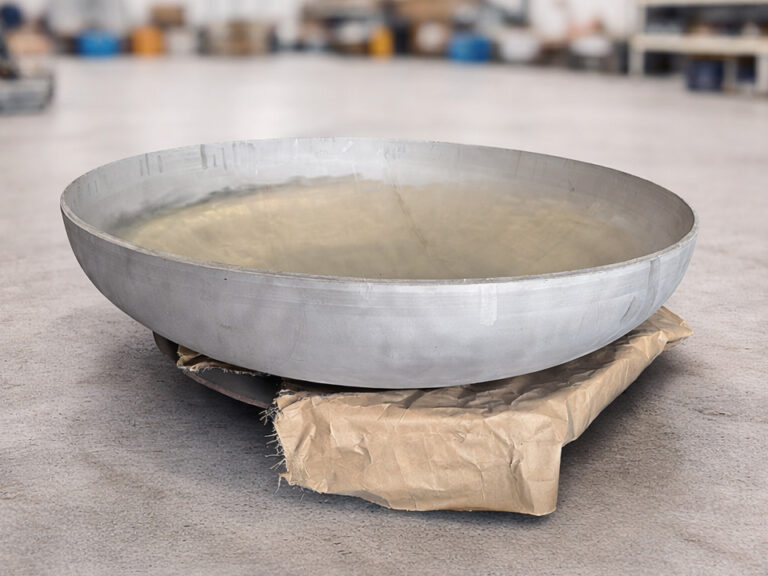
tank head size
The Secret’s in the Curves
A torispherical head isn’t just “a dome with a bend.” To qualify as an ASME flanged and dished (F&D) head—the official term—you’ve got to nail two specific radii:
The crown radius (that big, shallow dish in the middle) must equal the outside diameter (OD) of the vessel.
The knuckle radius (the tight curve where the head meets the cylinder) must be at least 6% of the OD—and never less than three times the head’s thickness.
Why the 6% Rule?
Why 6%? Because below that, stress spikes like crazy in the knuckle under pressure. Think of it like bending a paperclip: gentle curves handle force fine; sharp bends crack fast.
These aren’t suggestions. They’re requirements. And they exist because real vessels have exploded when designers ignored them.
elliptical tank dish head
Thickness Isn’t Guesswork—It’s Formula
Once you’ve got the right shape, ASME gives you a clean formula in UG-32(f) to calculate minimum required thickness based on:
Internal pressure
Material allowable stress
Vessel diameter
Those exact radii we just talked about
But—and this is critical—if your head doesn’t match the prescribed geometry, that formula no longer applies. Suddenly, you’re in FEA (finite element analysis) territory, which means expensive software, certified analysts, and weeks of validation. Not exactly feasible for a small shop building a steam receiver for a coffee roaster.
“ASME F&D” Isn’t Just Labeling—It’s a Promise
When you see a drawing stamped “Torispherical per ASME UG-32(f)” or “ASME F&D head,” it’s not marketing fluff. It means:
The geometry follows code-prescribed ratios
The thickness was calculated using the approved method
It can be stamped with the ASME “U” symbol (if the whole vessel qualifies)
That stamp? It’s your insurance policy. Literally. Insurance companies and regulators won’t touch a vessel without it.
Torispherical Head
The Bottom Line: Why Torispherical Heads Matter
Torispherical heads are popular not because they’re the strongest (hemispheres win that), but because they’re the smartest balance of safety, cost, and code compliance for most industrial applications—from food processing tanks to chemical reactors.
But—and I can’t stress this enough—they only deliver that balance when built to spec. “Close” doesn’t cut it. In pressure vessels, close gets people hurt.
So next time you’re reviewing a quote or a drawing, don’t just nod at the word “torispherical.” Ask: Is it ASME F&D? Does it meet UG-32(f)?
This structure uses clear H1 and H2 tags, helping the blog post maintain a readable and SEO-friendly format while breaking up the content into digestible sections.